
5 November 2026
The Stones of Indian Temples, and How to Choose One
By Y. Sompura
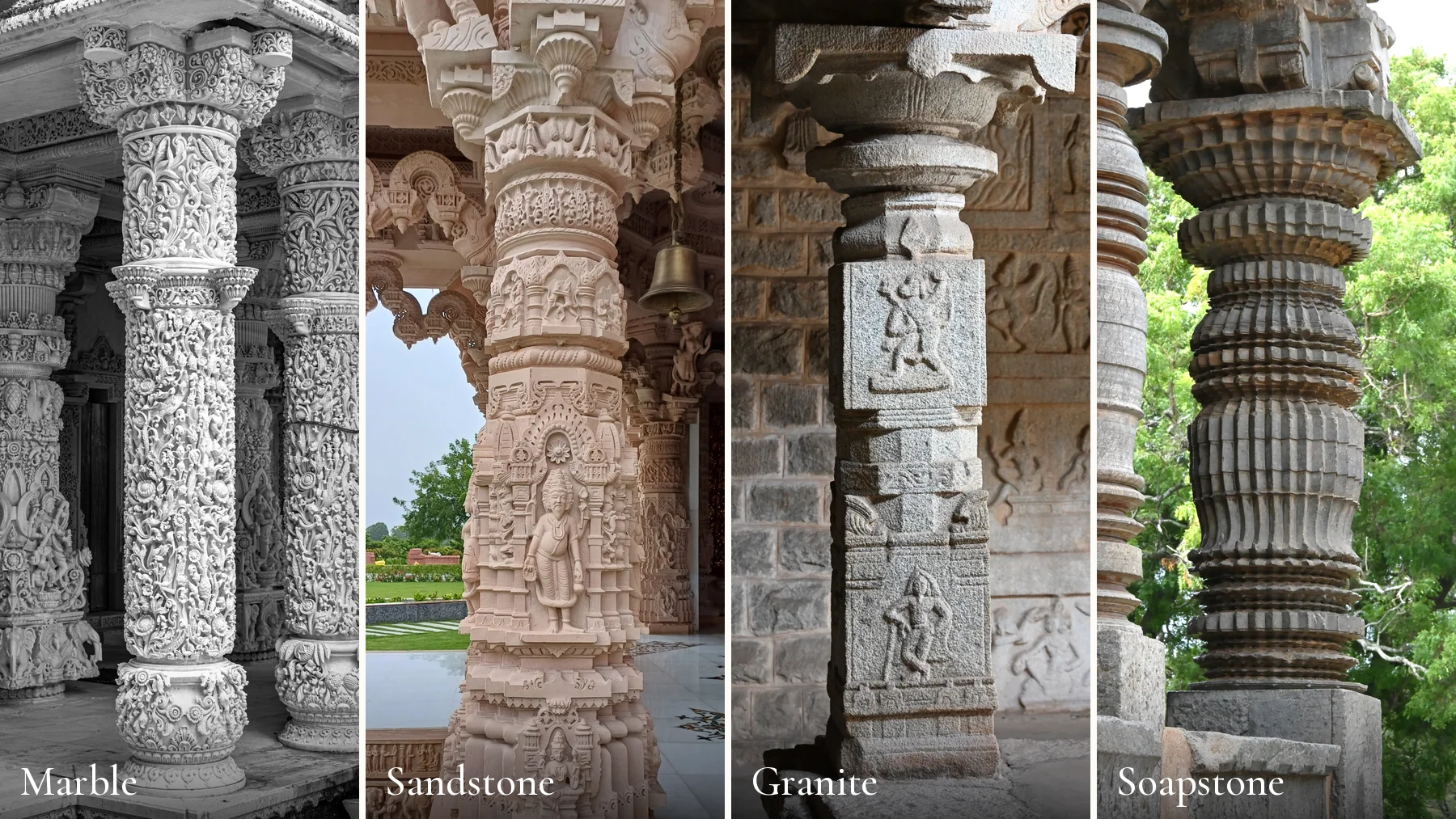
Marble, limestone, sandstone and granite carry most of the temples built in India today, and a few regional stones, soapstone among them, carry famous older ones. Choosing among them is one of the first decisions a trust makes, and it shapes how the temple looks, how it is carved and how it ages over the centuries.
Names such as Makrana or Bansi Paharpur are often spoken of as if each stood for one fixed quality. In practice every stone comes in many varieties from many quarries, and porosity and strength can change from one block to the next. This article goes through the main Indian varieties of each stone in short, and the regional stones of older temple traditions, with what is known about their porosity, strength and durability, and closes with how a trust can choose for its own site. Only stones of Indian origin are covered, because Indian temple building, its climate and its craft traditions have grown up around them.
Three things to look at in any stone
Porosity and water absorption. How much water the stone takes in, usually given as a percentage of its weight. A stone that absorbs less is less troubled by rain, damp and the salts that damp carries.
Strength. Compressive strength, in megapascals (MPa), is the load a block can carry before it fails. It matters most for columns, beams and the lower courses of a temple. Where a source reports it in kg/cm², the figure here has been converted to MPa and rounded.
Durability and carving. How the stone weathers, and how hard it is to cut. A harder stone costs more time to carve, but it also holds finer detail.
Marble
Marble is limestone that heat and pressure have turned into a dense mass of interlocking crystals. It is the stone of the Jain temple tradition of Gujarat and Rajasthan, whose benchmark is the Dilwara group on Mount Abu, built between the 11th and 13th centuries (see Figure 1). Marble takes a fine polish, absorbs little water and holds very fine carving. It is a carbonate stone, so acids damage it, and it needs a careful cleaning routine. Even white marble changes with age: the older marble at Dilwara has taken on a yellowish patina next to the newer white work. White marble temples among our projects include the Kalyan Shwetambar Jain Derasar at Vesu (see Figure 2), the Sultan Parshwanath Jain Tirth at Siddhpur and the Rikhavdev Jain Derasar at Jhagadia.
Figure 1
Carved Marble Ceiling Panels at the Dilwara Temples, Mount Abu
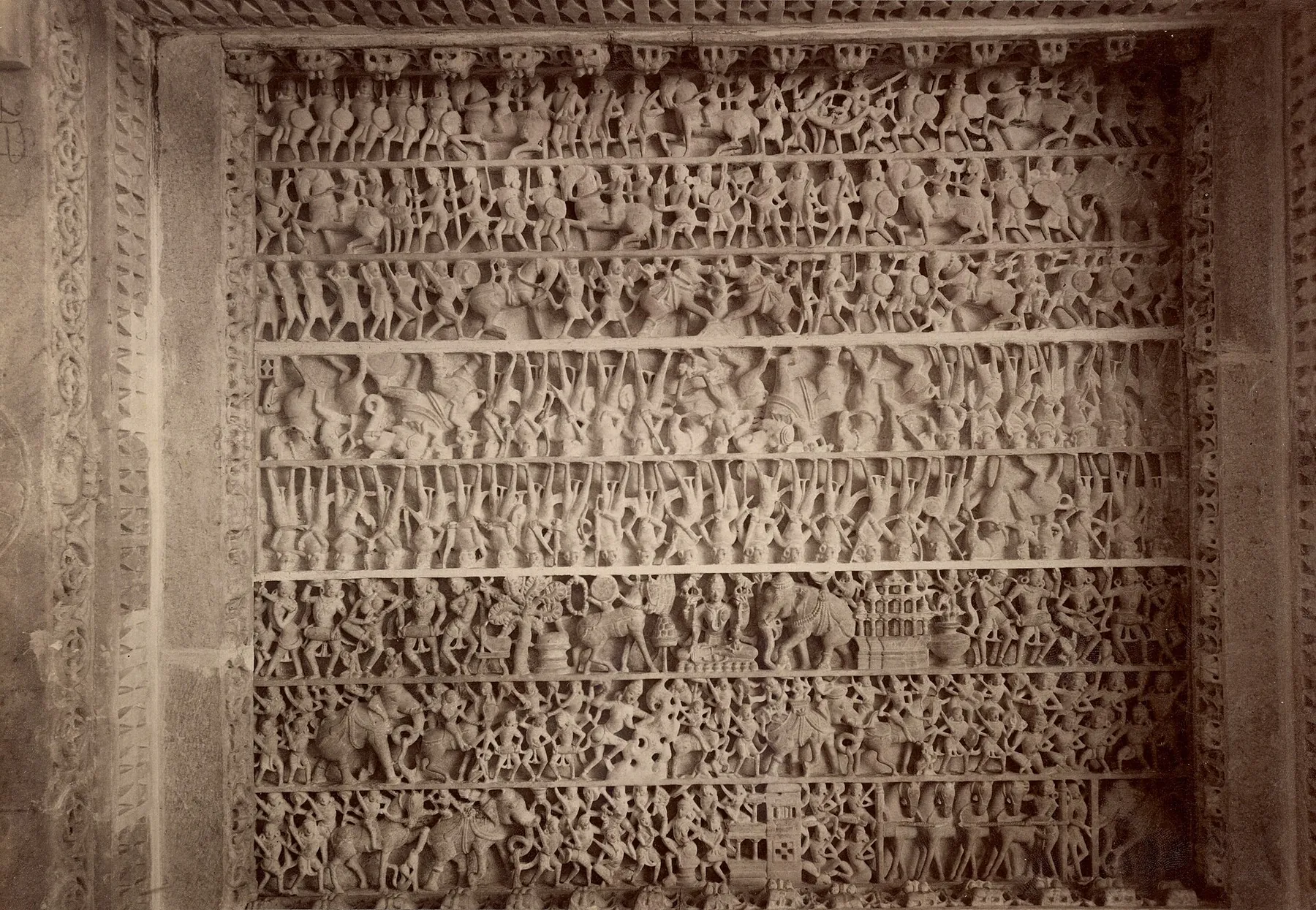
Note. Photograph by Lala Deen Dayal. From Wikimedia Commons. CC0.
- White Makrana. The marble used in the Taj Mahal, designated a Global Heritage Stone Resource in 2019. A calcitic marble of the Delhi Supergroup, formed in the Proterozoic (Garg, n.d.).
- Porosity: under 0.3 percent when fresh, which is very low. Repeated heating cycles raised it to around 2 percent in laboratory work at IIT Bombay, and measurements on marble in heritage structures run from 0.5 to 3.3 percent (Dixit, 2025).
- Durability: a long record on monuments. Heat and repeated wetting open up the pores, so harsh cleaning and fire exposure are best avoided.
- White Ambaji. A white marble. We built the rang mandap of the white marble temple Amba Ji Mandir.
- Rajnagar. A white marble.
- Banswara. A purple marble (Indian Bureau of Mines [IBM], 2021a).
Figure 2
White Marble Architecture at the Kalyan Shwetambar Jain Derasar, Vesu, Surat
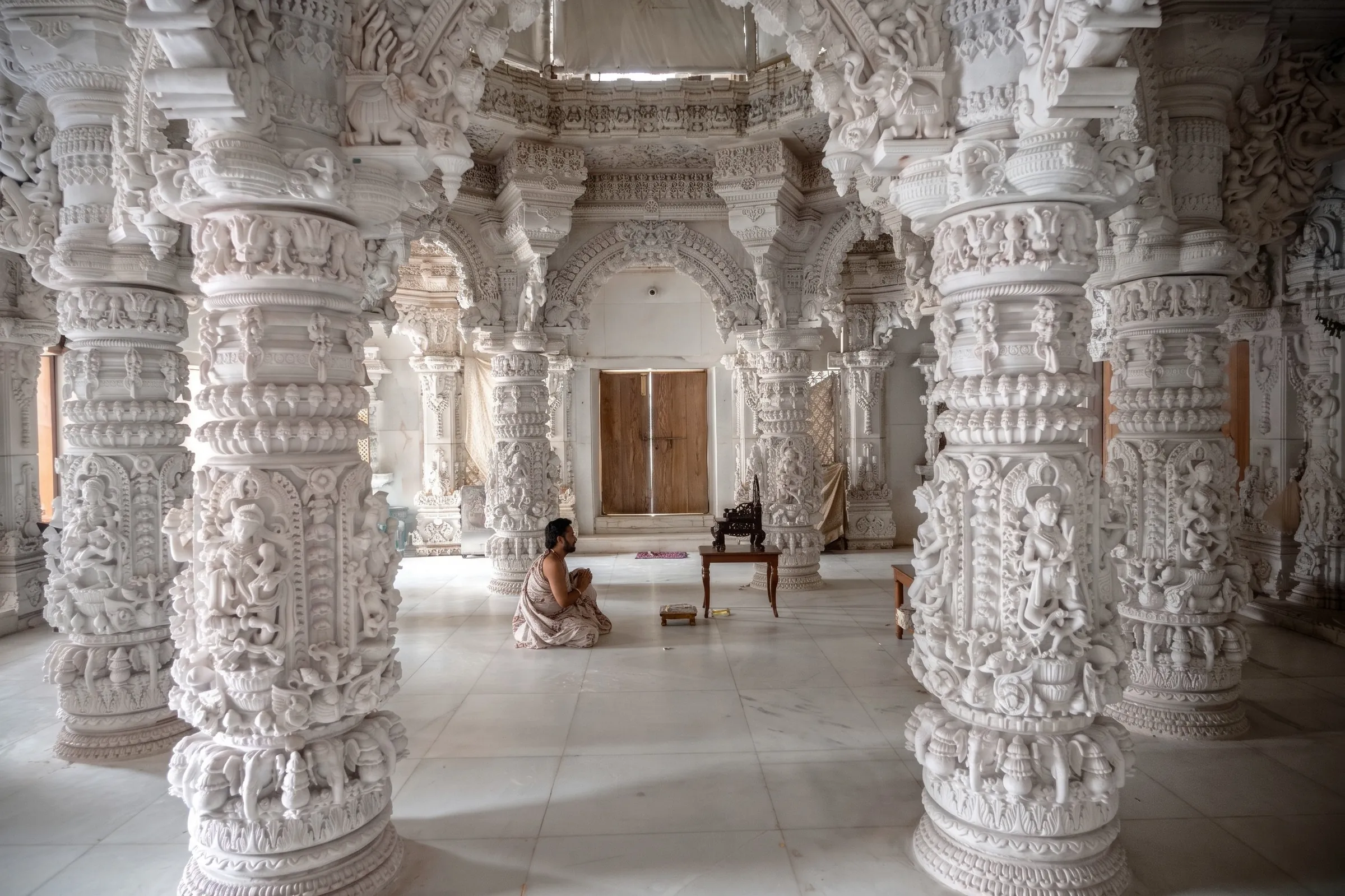
Note. Photograph © 2026 Y. Sompura.
Limestone
Limestone is a sedimentary stone made mostly of calcium carbonate. Some limestones are dense and fine-grained, others are softer and more open. Several are sold in the trade as marble or as sandstone, which can be confusing, so the geology is worth knowing.
- Yellow Jaisalmer. A golden-yellow limestone of the Middle to Late Jurassic Jaisalmer Formation, made of oolitic and bioclastic grains, and recognised as an IUGS Heritage Stone in 2022. It built Jaisalmer Fort (see Figure 3), the havelis and the Jain temples inside the citadel (Kaur, n.d.-a). The Jaisalmer region has a variety of yellow stones with different textures and colours: one type takes a polish like marble, another looks like sandstone.
- Durability: it has stood for centuries in the dry climate of the Thar.
Figure 3
Jaisalmer Fort, Built of Golden Jaisalmer Limestone
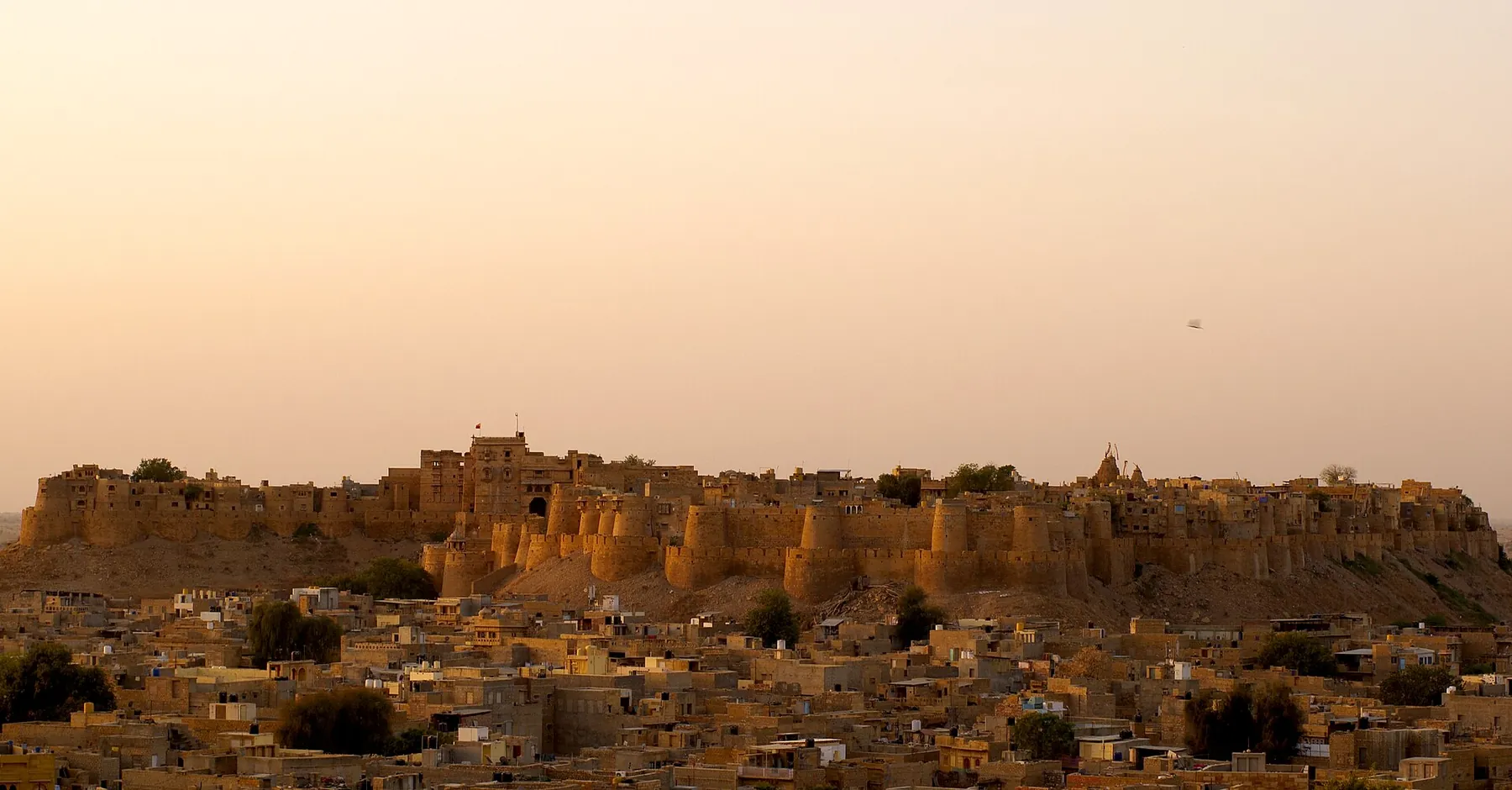
Note. Photograph by Vijainder K Thakur. From Wikimedia Commons. CC BY-SA 3.0.
Sandstone
Sandstone is sand grains cemented together, so its strength and porosity depend on how well the grains are cemented. Two stones sold as sandstone can behave very differently. It is warmer in colour than marble and kinder to the chisel, and it suits deep relief, tall shikharas (see Figure 4) and load-bearing columns. Its weak point is that most sandstone absorbs more water than marble or granite, so it needs a protective treatment and good detailing.
As a benchmark, the Indian Standard for sandstone slabs and tiles (IS 3622) allows water absorption of not more than 2.5 percent and asks for a transverse strength of at least 7 N/mm² (Bureau of Indian Standards, 1977). Individual varieties differ.
Figure 4
Sandstone Shikharas of the Kandariya Mahadeva Temple, Khajuraho
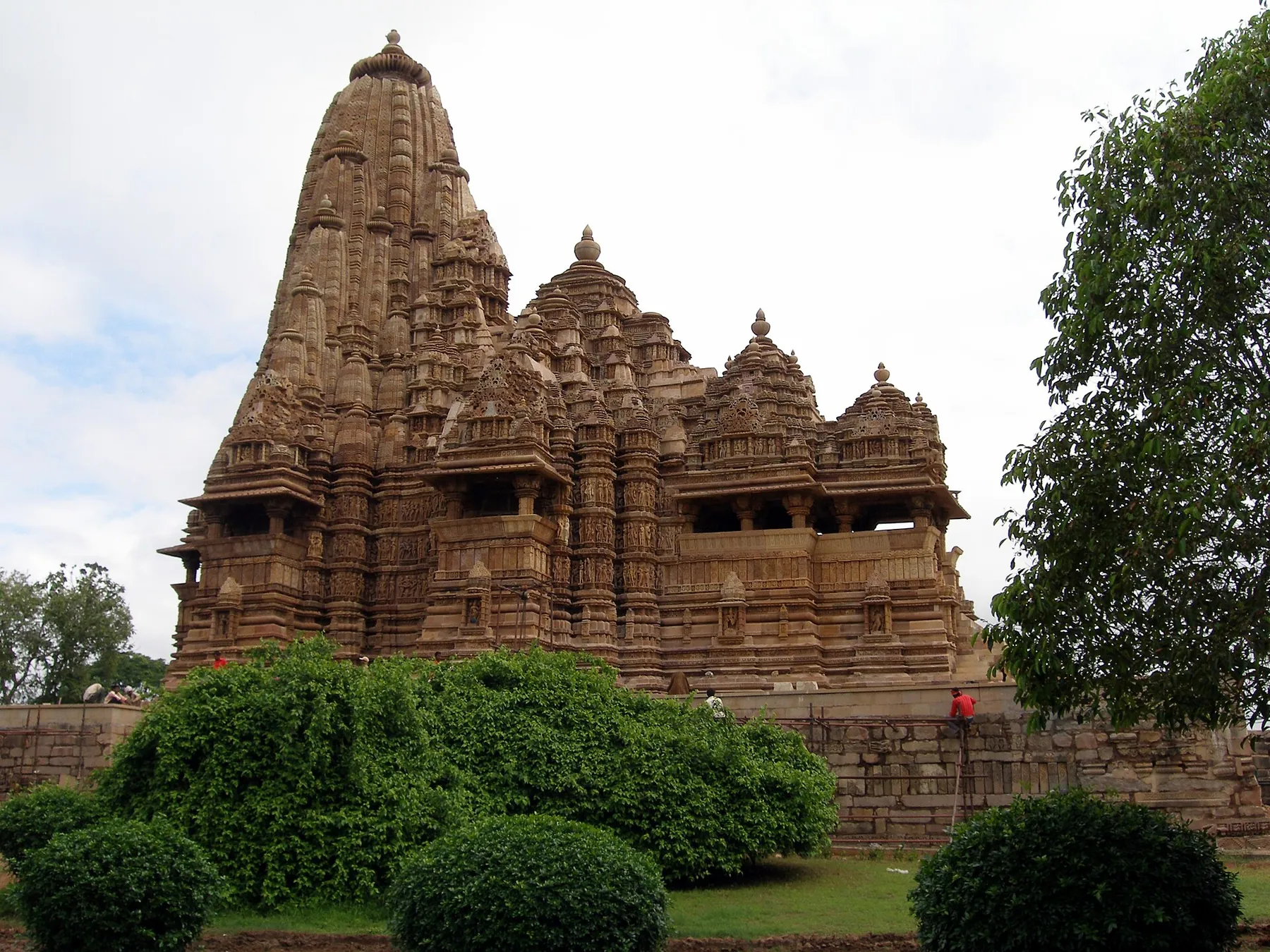
Note. Photograph by China Crisis. From Wikimedia Commons. CC BY-SA 3.0.
- Bansi Paharpur. The most used stone in recent temples, for its distinctive tone, durability and cost. It is the pink sandstone of the Ayodhya superstructure and is also used at Khodal Dham. Tones run from pale pink to warm rose. It is a Vindhyan sandstone, the family that also built Sanchi, the Khajuraho temples and Chittorgarh Fort (Kaur, n.d.-b).
- Porosity: more porous than marble.
- Durability: good, though because it absorbs water it needs an additional protective coating.
- Dholpur. A Vindhyan sandstone, traded as Dholpur cream (IBM, 2021b).
- Jodhpur. A major heritage stone of Rajasthan.
- Dhrangadhra. A sandstone quarried in Saurashtra and a natural local choice for temples in the region. It is easy to cut and carve, which lowers the overall project cost; the trade-off is that it decays faster than the other stones.
- Khavda. Sandstones from Kachchh run from white and cream to reddish brown and yellow (IBM, 2021b).
- Khajuraho. The Chandela temples of Khajuraho are built of sandstone brought from quarries about 30 km away, with granite for the base of the Chaturbhuja temple (Dinshaw, 2017). Vindhyan sandstone is durable and workable, and suits intricate carving and jali screens (Kaur, n.d.-b).
- Early Chalukya sandstone. Quarried at Motara Maradi, in the hills north of Pattadakal, for the early temples of the Badami and Pattadakal region (Menon, 2017; see Figure 5).
Figure 5
Early Chalukya Sandstone Temple Tower, Karnataka
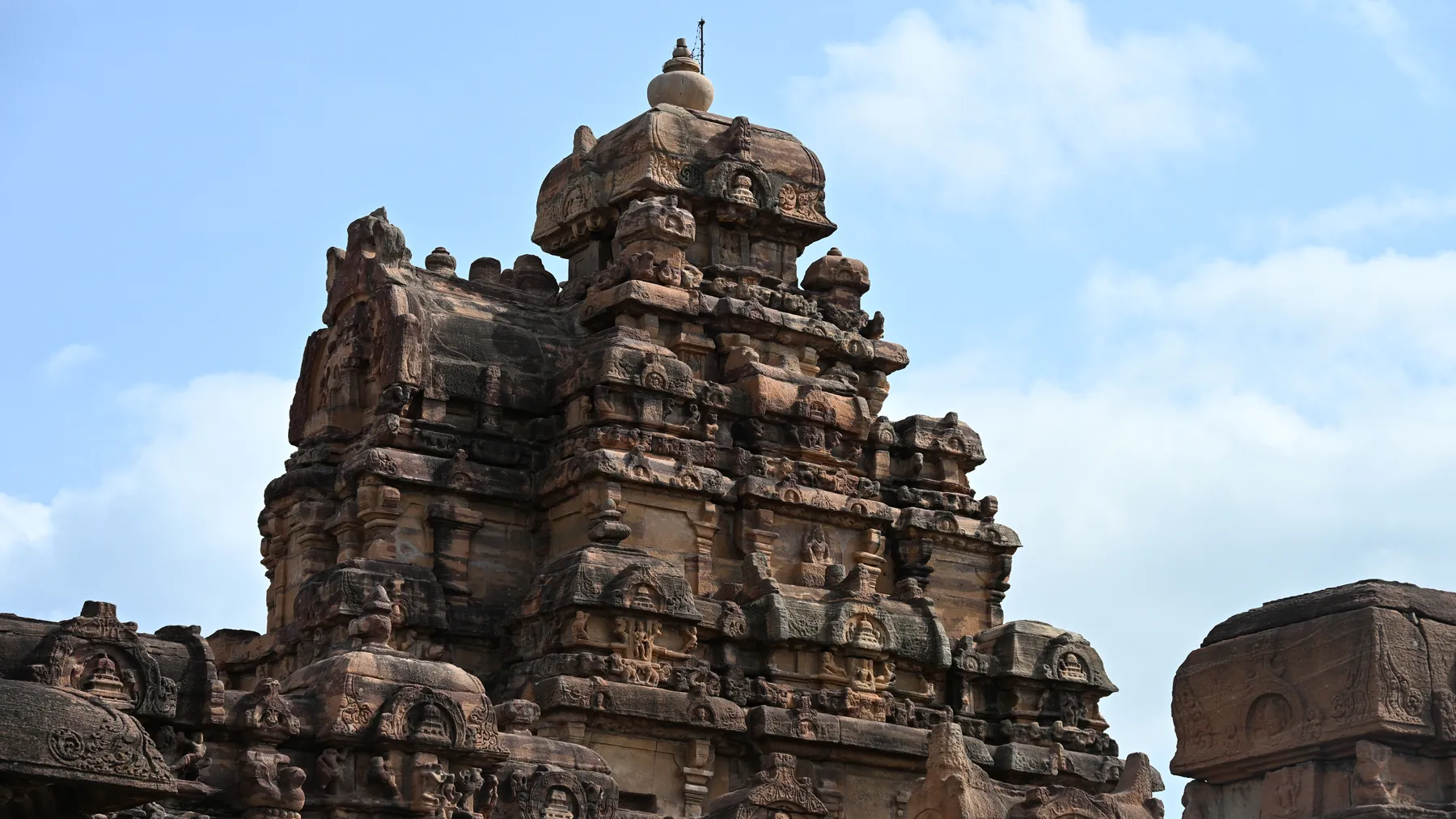
Note. Photograph © 2026 Y. Sompura.
Pink sandstone temples among our projects include the Umiya Mata Mandir at Sola (see Figure 6), the Bhid Bhanjan Hanuman Mandir at Sakariya and the Lambhvel Hanuman Mandir at Anand.
Figure 6
Pink Sandstone at the Umiya Mata Mandir, Sola
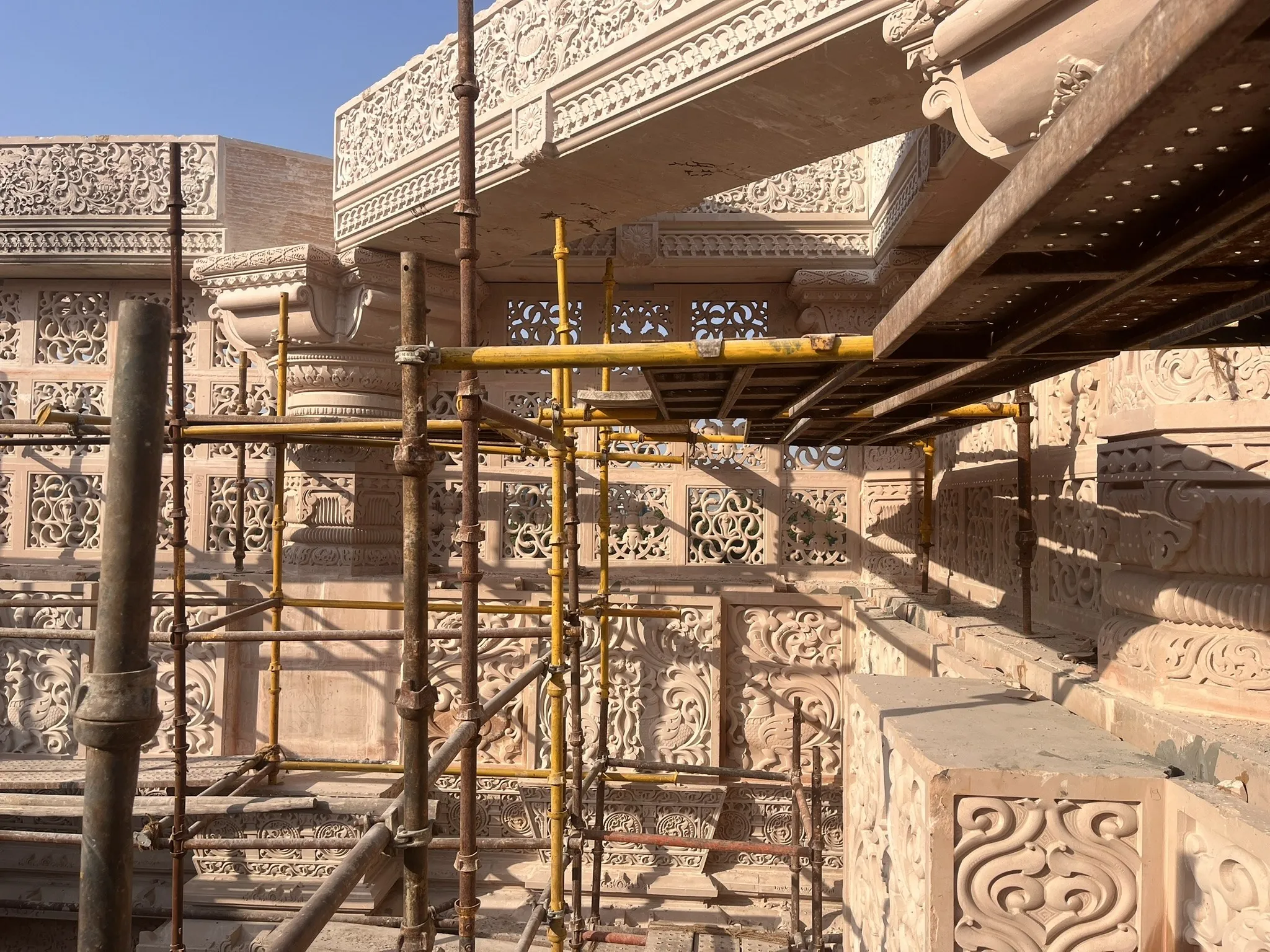
Note. Photograph © 2026 Y. Sompura.
Granite
Granite is a hard, coarse-grained igneous rock. Of the main stones here it is the hardest and the least porous, which makes it the most weather-resistant, and also the hardest to carve: tools wear quickly, and fine detail takes longer and costs more. Many South Indian temples are built of granite: Pallava craftsmen carved the granite hills of Mahabalipuram, the Cholas built in granite, and the Vijayanagara builders turned the granite boulders of Hampi into temple complexes (Hardy, 2007; see Figure 7). Kerala temples set their laterite walls on a granite plinth, a barrier against ground moisture (Viswanath, 2025). In temples of every region it is a common choice for foundations and plinths, where strength matters more than fine carving.
Figure 7
Granite Boulders and Temple Ruins at Hampi, Karnataka
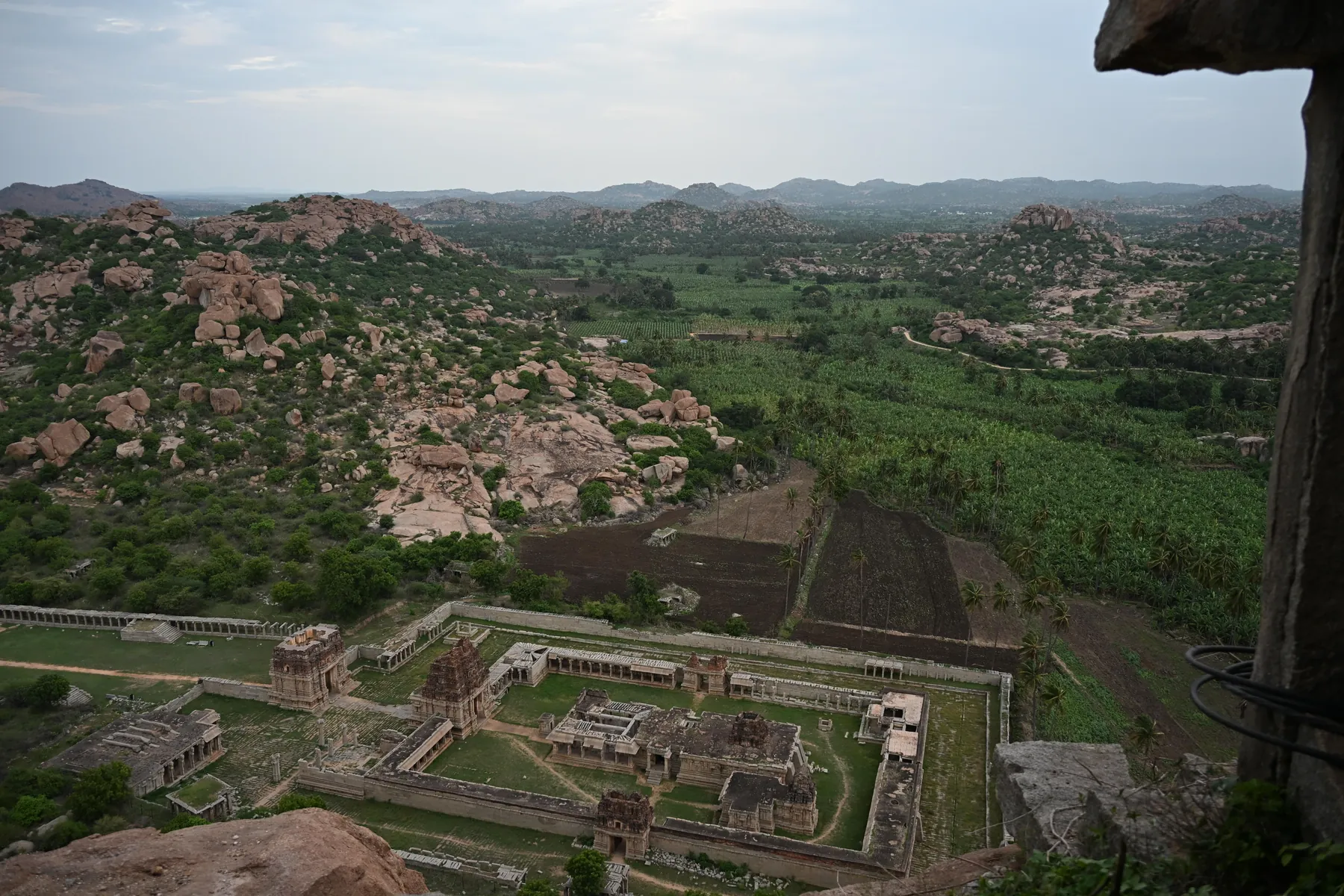
Note. Photograph © 2026 Y. Sompura.
Rajasthan. A study of commercial granites from the Jalore and Barmer region measured water absorption and compressive strength for each (Kaushal & Agrawal, 2023):
- Kharda Red. Porosity: 0.05 percent water absorption. Strength: about 188 MPa.
- Mokalsar Green. Porosity: 0.09 percent. Strength: about 156 MPa.
- Bala Flower. Porosity: 0.11 percent. Strength: about 133 MPa.
- Chima Pink. Porosity: 0.43 percent. Strength: about 129 MPa.
- Merry Gold. Porosity: 0.70 percent. Strength: about 117 MPa.
- Imperial Pink. Porosity: 0.15 percent. Strength: about 108 MPa.
Durability across all of these is very high. The authors link strength to the minerals in each granite and to the way the grains are arranged.
South India.
- Madurai region. Five granites from the Pandiyan mobile belt in Tamil Nadu absorbed between 0.18 and 0.30 percent water, with porosity from 0.17 to 0.24 percent. A sample from Sankarankovil reached 89 MPa. The authors judged the Madurai granites well suited to civil engineering work in general (Sivapragasam et al., 2012).
Regional temple stones
Older temple traditions grew out of the stone of their own landscape. Where a hillside could be cut as a whole, as at Ellora, or a quarry gave sound blocks, as at Khajuraho, large temples followed. Stones that come only as thin slabs never became temple stones: flaggy limestones such as Kota stone are sold as slabs 12 to 50 mm thick (IBM, 2021b), good for floors and cladding, while a temple needs blocks large enough for columns, beams and lintels.
Figure 8
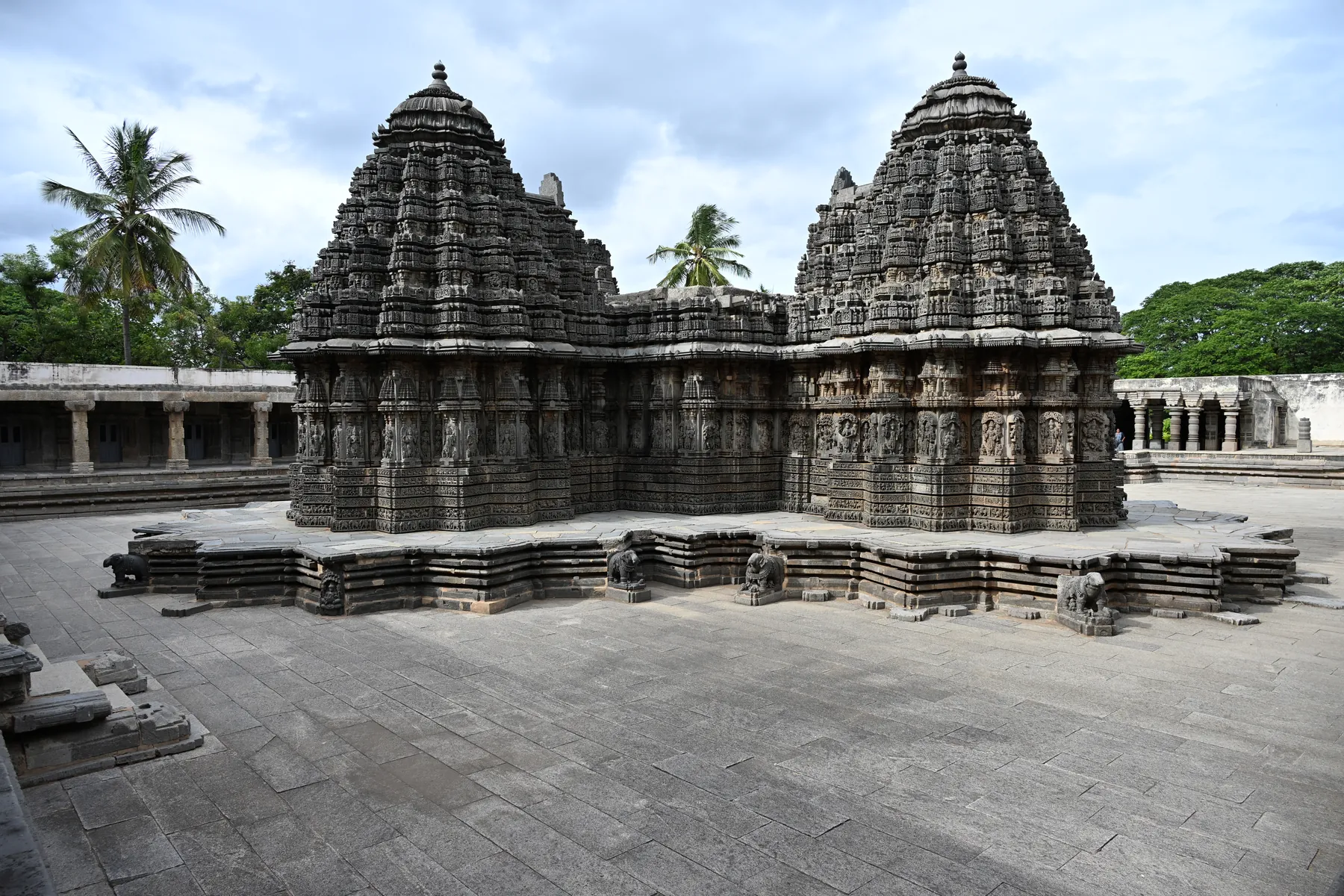
A Hoysala Temple of Soapstone, Karnataka
Note. Photograph © 2026 Y. Sompura.
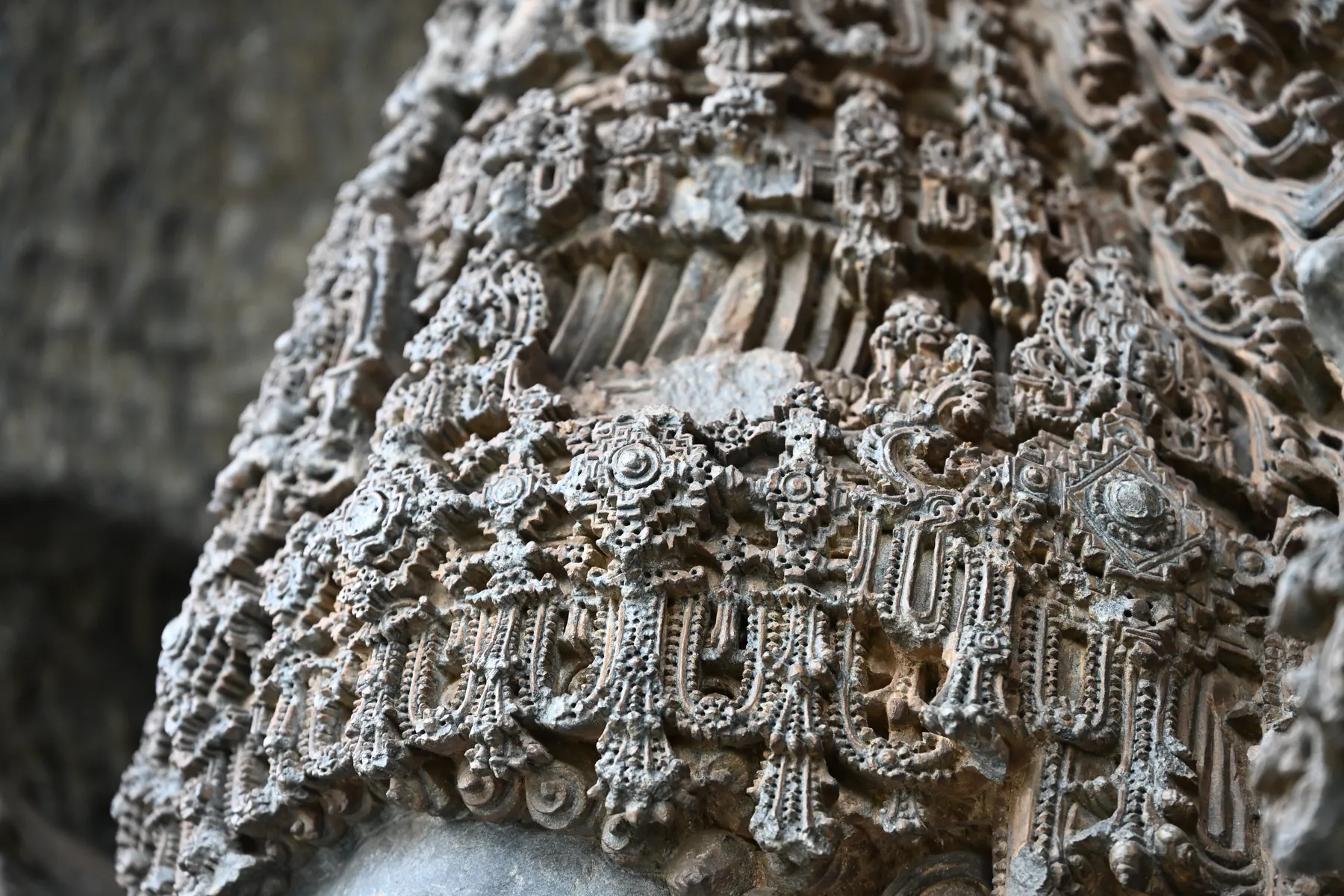
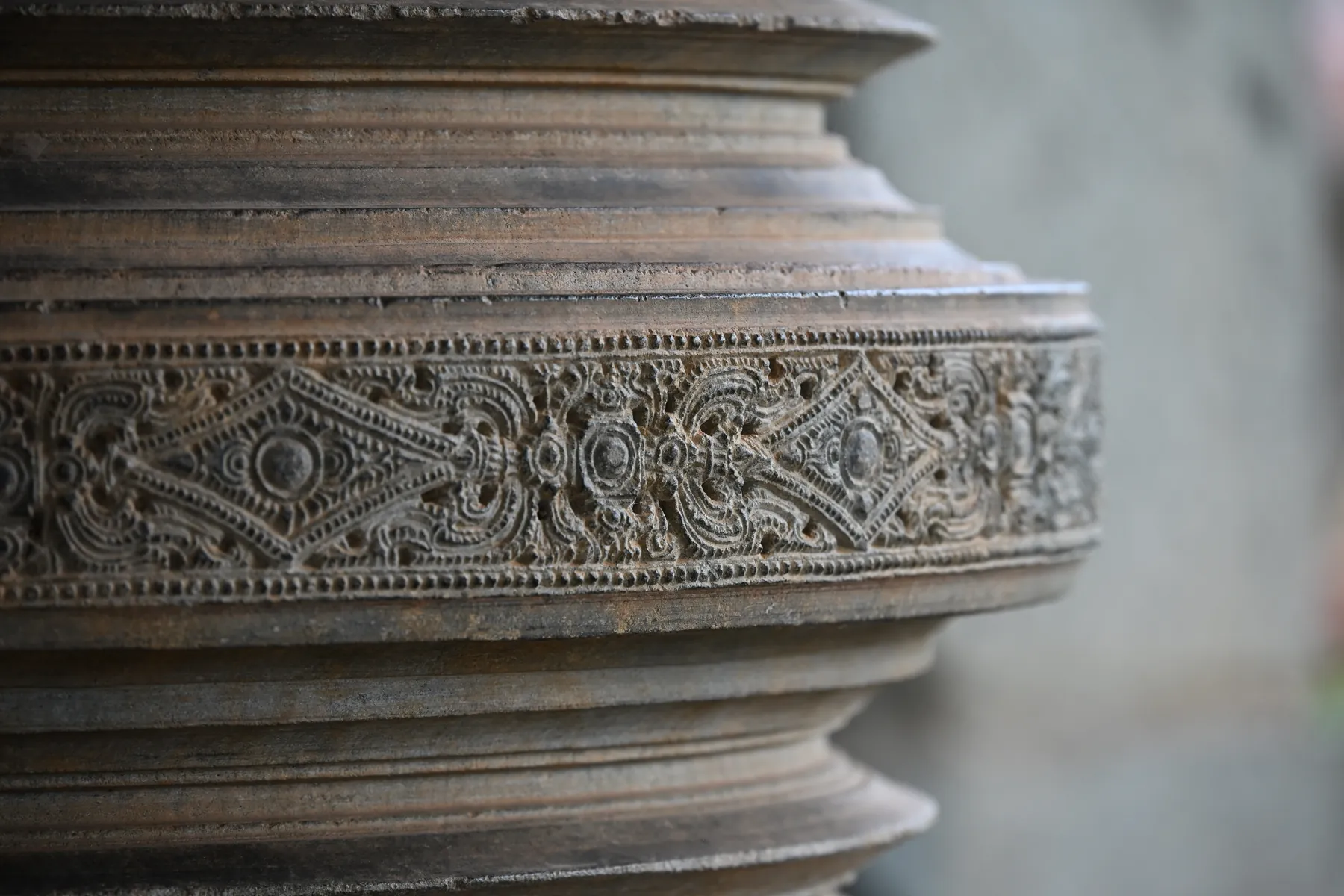
- Soapstone (chloritic schist). The stone of the Hoysala temples of Karnataka (see Figure 8), among them the Chennakeshava temple at Belur and the Hoysaleswara temple at Halebidu. Geologists call it chloritic schist, a greenish metamorphic rock rich in talc and chlorite; soapstone is its common name. In Karnataka it became the preferred material of the Western Chalukya temples around Lakkundi, where it allowed virtuosic undercutting and polished pillars, and the Hoysala carvers drilled, grooved and undercut it further (Hardy, 2007). It was quarried extensively near the Hoysala temples, especially for carving statues (Dinshaw, 2020), and a seated Ganesha from Halebidu, of the 12th to 13th century, is one of its carved icons (Smithsonian's National Museum of Asian Art, n.d.).
- Hardness: soft, 2 to 3 on the Mohs scale, because of its talc (Dinshaw, 2020).
- Carving: soft enough to allow the detailed carving and ornament of Hoysala temples (Smithsonian's National Museum of Asian Art, n.d.; see Figures 9 and 10).
- Durability: it hardens once exposed to the air (Dinshaw, 2020). At Belur and Halebidu, conservation work has replaced missing pieces and floors with carved soapstone matching the original (Kumaran & Saranya, 2025).
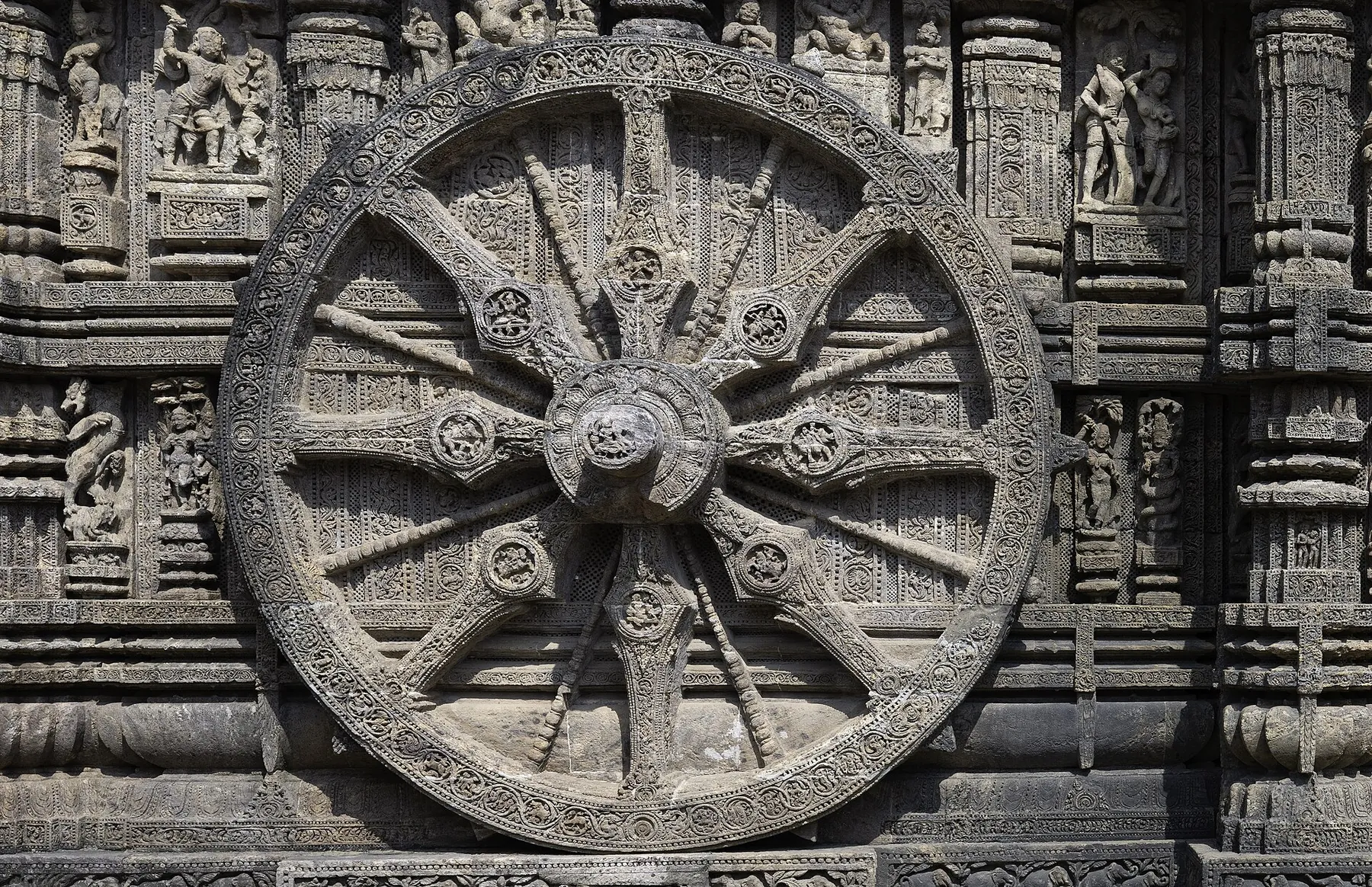
- Khondalite. The stone of the Konark Sun Temple in Odisha (see Figure 11), where it carries the carved sculpture of the main temple, the Jaga Mohan and the Natya Mandir. Laterite was used for the foundations and side walls, and chlorite for the throne, the cult icons and some door frames (Mohapatra, 2023).
- Durability: a banded rock of quartz, feldspar, garnet and sillimanite. Its feldspar bands and garnets weather to clay minerals, which has disfigured the carving in places (Mohapatra, 2023).
- Basalt (Deccan trap). The Kailasa temple at Ellora (see Figure 12) was hewn from Deccan trap, a coarse volcanic stone that gives chunkier detail than sandstone. The Kakatiya temples are mostly of grey basalt (Hardy, 2007).
- Laterite. Kerala temples set laterite walls under sloping roofs on a granite plinth (Viswanath, 2025). Laterite is easy to quarry and cut when fresh, and gains a little strength on exposure to the air.
- Porosity: high. It is highly hygroscopic, and moisture is the main cause of its decay (Viswanath, 2025).
- Size: it suits low-rise building of two or three storeys, and its porosity makes thin, large slabs hard to cut (Viswanath, 2025).
Figure 9
Fine Undercut Carving in Soapstone on a Hoysala Temple, Karnataka
Note. Photograph © 2026 Y. Sompura.
Figure 10
Lathe-Turned Soapstone Pillar Inside a Hoysala Temple, Karnataka
Note. Photograph © 2026 Y. Sompura.
Figure 11
Carved Stone Wheel of the Konark Sun Temple, Odisha
Note. Photograph by Joydeep. From Wikimedia Commons. CC BY-SA 4.0.
Figure 12
The Kailasa Temple at Ellora, Hewn from a Single Rock
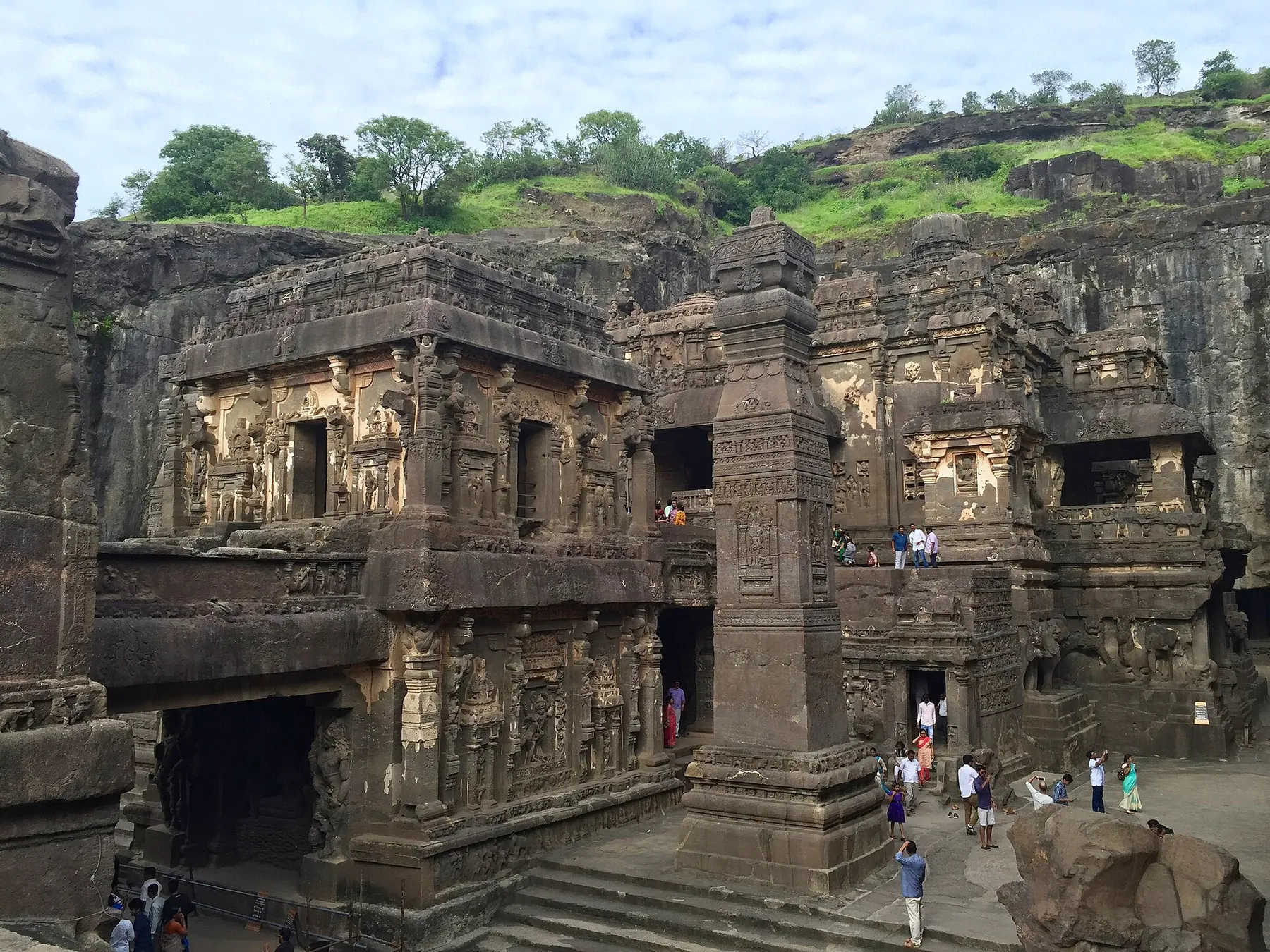
Note. Photograph by Ms Sarah Welch. From Wikimedia Commons. CC BY-SA 4.0.
One stone, or more than one?
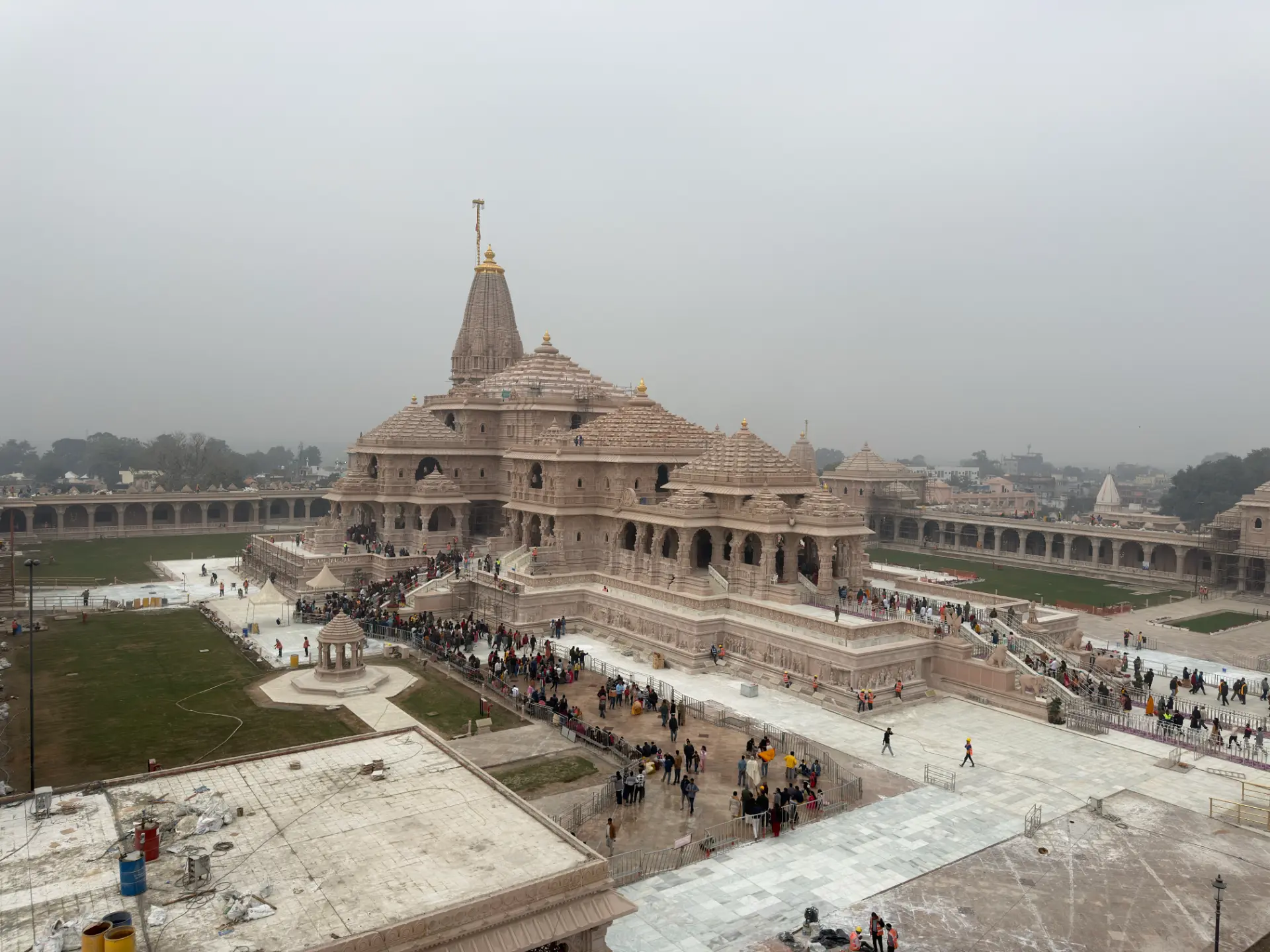
Most temples being built today use a single stone throughout. Where a second stone is brought in, it is usually marble, for the garbhgriha and sometimes the doorframes. The Shri Ram Janmabhoomi Mandir at Ayodhya follows this pattern (see Figure 13): the superstructure is pink sandstone, while the backdrop of the garbhgriha is white marble. Dilwara is marble from base to ceiling, and Jaisalmer Fort is limestone from end to end. The simplest approach for a trust is to pick one stone for the whole temple, and to treat marble in the garbhgriha as a separate choice.
Figure 13
Pink Sandstone Superstructure of the Shri Ram Janmabhoomi Mandir, Ayodhya
Five things a trust can weigh
- Tradition. Which stone does your community's main tirth or temple use for this deity?
- Carving. How fine should the carving be? Ask the contractors for a sample in each stone, and for how the cutting time compares. Granite is the hardest to cut and sandstone the easiest.
- Colour and setting. How does each stone look in sun and in shade at your site?
- Cost and supply. Ask for quotes in each stone, and for the block sizes available.
- Care and tests. Ask for test certificates for the actual quarry, covering water absorption (IS 1124) and compressive strength (IS 1121), and ask how the stone ages in your climate and what upkeep it needs.
Conclusion
Indian marble, limestone, sandstone and granite are all proven temple stones. Marble offers a fine polish, a white setting and very low water absorption, and asks for patience in the carving and care in cleaning. Limestone, in the golden stone of Jaisalmer, offers warm colour in forms that polish like marble or carve like sandstone. Sandstone offers warmth of colour and an easier cut, and asks for protection from water. Granite offers the greatest strength and weather resistance, and asks for the most work to carve. Regional traditions add stones of their own, such as the soapstone of Hoysala Karnataka and the khondalite of Odisha. Within each family the varieties differ, and the right choice depends on a trust's tradition, its site and its climate. It is best settled with samples and test certificates in hand, not on a photograph or a name.
If you are choosing a stone for a temple, write to us through the Contact page with the site and the community, and we will show you samples and projects in each. You can also browse all our projects.
Cover image: photographs © 2026 Y. Sompura. Photographs from Wikimedia Commons are credited beneath each image.
References
Bureau of Indian Standards. (1977). Specification for sandstone (slabs and tiles) (IS 3622:1977, 1st rev.).
Dinshaw, K. (2017, June 22). Khajuraho stone temples of India. Deposits Magazine. https://depositsmag.com/2017/06/22/khajuraho-stone-temples-of-india/
Dinshaw, K. (2020, July 8). Belur and Halebidu stone temples, Karnataka, India. Deposits Magazine. https://depositsmag.com/2020/07/08/belur-and-halebidu-stone-temples-karnataka-india/
Dixit, R. (2025, November). How not to lose your marble. Shaastra, 4(10). https://shaastramag.iitm.ac.in/special-feature/how-not-lose-your-marble
Garg, S. (n.d.). Makrana marble. IUGS Heritage Stones Subcommission. https://iugs-geoheritage.org/?p=9618
Hardy, A. (2007). The temple architecture of India. Wiley.
Indian Bureau of Mines. (2021a). Marble. In Indian minerals yearbook 2020: Part III. Mineral reviews (59th ed.). Ministry of Mines, Government of India. https://ibm.gov.in/writereaddata/files/07132021132452Marble%202020.pdf
Indian Bureau of Mines. (2021b). Slate, sandstone and other dimension stones. In Indian minerals yearbook 2019: Part III. Mineral reviews (58th ed.). Ministry of Mines, Government of India. https://ibm.gov.in/writereaddata/files/05022022154826Slate_Other%20Dimension_2019.pdf
Kaur, G. (n.d.-a). Jaisalmer limestone. IUGS Heritage Stones Subcommission. https://iugs-geoheritage.org/geoheritage_stones/jaisalmer-limestone/
Kaur, G. (n.d.-b). Vindhyan sandstone. IUGS Heritage Stones Subcommission. https://iugs-geoheritage.org/geoheritage_stones/vindhyan-sandstone/
Kaushal, K., & Agrawal, V. (2023). Correlation between the petrography and physico-mechanical properties of commercial granites of Jalore–Barmer region, Rajasthan, India. Journal of Scientific Research, 67(3), 11–17. https://doi.org/10.37398/JSR.2023.670302
Kumaran, R. N., & Saranya, M. (2025). Sacred ensembles of Hoysalas. Heritage: Journal of Multidisciplinary Studies in Archaeology, 10, 82–109. https://heritageuniversityofkerala.com/JournalPDF/Volume10/4.pdf
Menon, S. M. (2017). Temples of memory: The Bhutnath temple environs at Badami as a commemorative landscape. Heritage: Journal of Multidisciplinary Studies in Archaeology, 5, 576–605. https://core.ac.uk/download/484057436.pdf
Mohapatra, G. P. (2023). Konark temple of Odisha: Some geological aspects of this grand heritage. GeoChronicle Panorama, 3(1), 1–11. https://cehesh.in/contents/GeochroniclePanorama2023/1.%20Mohapatra_Konark%20Temple_pp.1-11.pdf
Sivapragasam, C., Venkat Reddy, D., Prabakaran, K., Vigneswaran, M., Senthilkumaran, S., Sivaprasath, C., & Varun Kumar, M. (2012). Physico-mechanical properties of select granitoidal rocks from a part of Pandiyan mobile belt, India. International Journal of Earth Sciences and Engineering, 5(3), 437–441.
Smithsonian's National Museum of Asian Art. (n.d.). Seated Ganesha (S1987.960). https://asia.si.edu/education/educator-resources/encountering-religion-in-asian-art/explore-by-object/object/seated-ganesha
Viswanath, M. (2025). Endemic architectural forms of Malabar and South Canara: The role of building material in shaping megaliths and temples. Indian Journal of Traditional Knowledge, 24(5), 487–499. https://doi.org/10.56042/ijtk.v24i5.12132